The Missing Plastic Has Been Found. The News Is Not Good.
For decades, scientists tracking plastic pollution ran into the same problem. They could calculate how much plastic had been produced, estimate how much had been discarded, and measure what was visible in the ocean. The numbers never added up. A significant share of the plastic was simply missing.
Two studies published in the last year suggest it was never gone. It had just become invisible.
What the Science Found
In July 2025, researchers from the Royal Netherlands Institute for Sea Research (NIOZ) and Utrecht University published findings in Nature that reframed the missing plastic question. Their study produced the first quantitative estimate of nanoplastics in ocean water at scale. Sampling at 12 locations across the North Atlantic, from the Azores to the European continental shelf, the team filtered seawater down to particles smaller than one micrometer and used mass spectrometry to identify the plastic molecules remaining. (NIOZ, July 9, 2025)
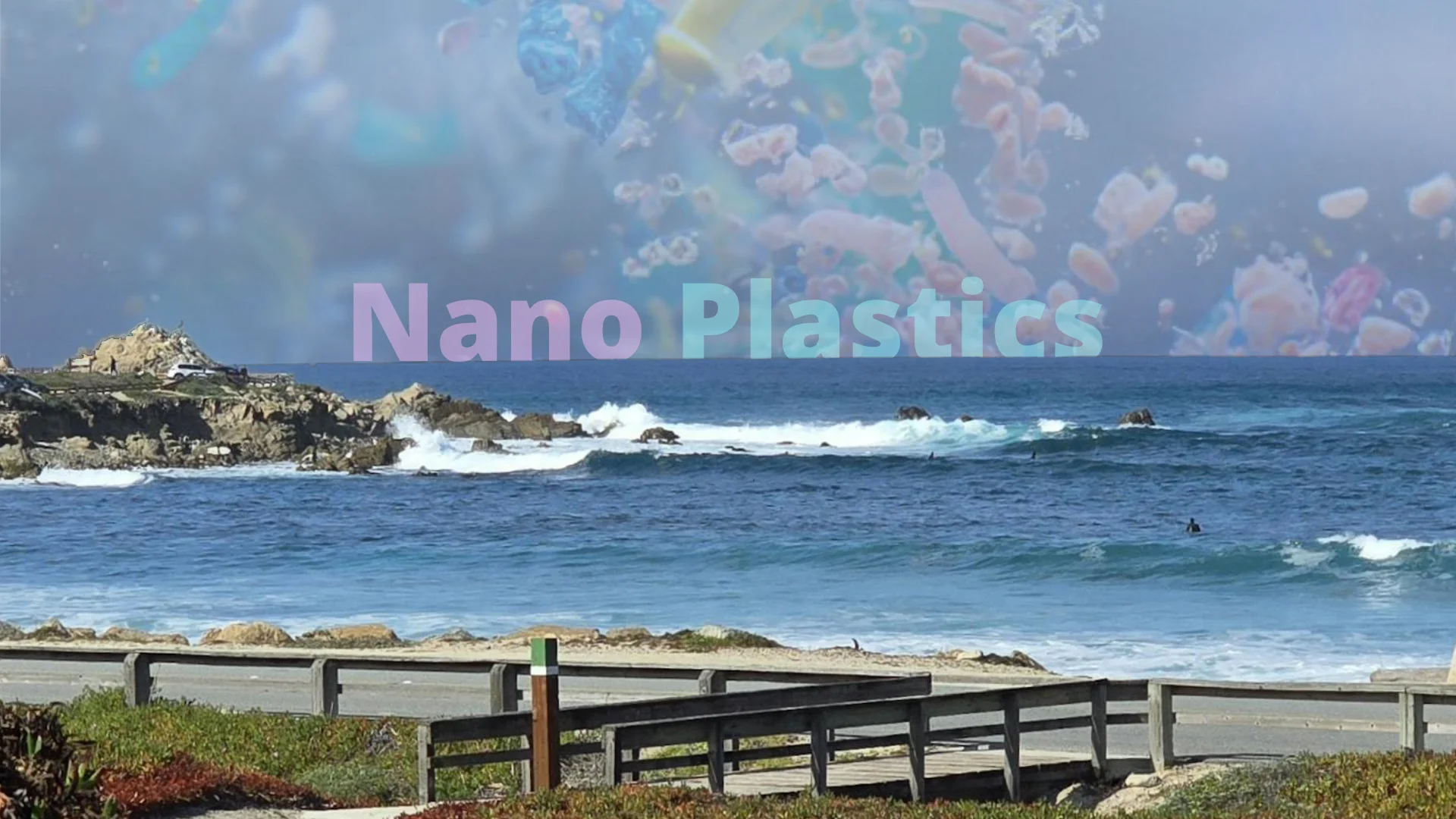
The estimate they arrived at: roughly 27 million tons of nanoplastics suspended in the North Atlantic alone. That is more than the total mass of all larger micro- and macroplastics floating in the Atlantic and all the world’s oceans combined. “A shocking amount,” said lead researcher Sophie ten Hietbrink. “But with this, we do have an important answer to the paradox of the missing plastic.” (NL Times, July 12, 2025)
NIOZ republished the findings for a broader audience on March 29, 2026. The core message was unchanged but the implications had sharpened. Helge Niemann, professor of geochemistry at Utrecht University and co-lead on the study, put it plainly: “The nanoplastics that are here now, you will never clean up.” (ScienceDaily, March 29, 2026)
How Nanoplastics Travel
Nanoplastics reach the ocean through several pathways. Larger plastic debris fragments over time through sunlight exposure. Rivers carry particles from land into coastal waters. And increasingly, researchers are finding that nanoplastics move through the atmosphere, falling into the ocean with rain or settling directly onto the surface. (ScienceDaily, March 29, 2026)
That last pathway has taken on new significance. A study published May 4, 2026, in Nature Climate Change, led by researchers from Fudan University and Duke University, found that the Great Pacific Garbage Patch is a meaningful source of airborne nanoplastics and microplastics. As pieces of plastic in the patch collide and break down, particles small enough to become airborne are released into the atmosphere. “Nanoplastics are tiny but powerful,” said atmospheric scientist Hongbo Fu, the study’s lead author. “They stay in the air longer and, for the same mass, they absorb much more sunlight than microplastics.” (CNN, May 4, 2026)
The study found that airborne microplastics and nanoplastics contribute to warming at roughly 16% the rate of black carbon, or soot. In ocean areas with high plastic concentrations, including the Great Pacific Garbage Patch, that warming effect may actually exceed that of black carbon. (CNN, May 4, 2026)
The Pacific Connection
The Great Pacific Garbage Patch sits between Hawaii and California, a swirl of plastic debris spanning an area more than twice the size of Texas. It is not a solid island of trash but a diffuse concentration of plastic caught in the North Pacific gyre. Microplastics and nanoplastics now make up an estimated 94% of all individual pieces in the patch. They are far too small and too dispersed to remove. (Save the Water, July 2025)
The NIOZ study focused on the North Atlantic, but the researchers themselves note that early indications suggest comparable nanoplastic concentrations in other ocean basins. The physics are not specific to one ocean. Plastic breaks down under sunlight everywhere. Gyres concentrate debris everywhere. The atmospheric transport pathways the Fudan/Duke study describes are global. The North Atlantic findings are, in all reasonable scientific inference, a window into what is happening in the Pacific as well. (ScienceDaily, March 29, 2026)
California’s rivers and stormwater systems feed into that Pacific system. Urban runoff from Los Angeles, the Bay Area, and the Central Valley carries plastic particles into coastal waters that eventually connect to the gyre. The nanoplastics accumulating in the North Atlantic did not originate there. They came from the same sources, the same consumer economy, the same inadequate collection and recycling infrastructure, that feeds the Pacific too.
What We Still Don’t Know
The NIOZ team could not detect certain common plastics, including polyethylene and polypropylene, in the smallest particle range. Niemann acknowledges that these may have been masked by other molecules in the analysis, and that further research is needed. The ecological consequences of nanoplastics at this scale are still being studied. It is already established that nanoplastics can penetrate living tissue. They have been found in human brain tissue. What chronic exposure means for marine food webs, and for the humans who eat from them, is not yet fully understood. (NL Times, July 12, 2025)
The climate implications of airborne nanoplastics are similarly early-stage. The Fudan/Duke study has real limitations, as outside experts noted, and the global warming contribution of airborne plastics remains a fraction of that from fossil fuels. But the research reveals a dimension of plastic pollution that few had considered before: that once plastic reaches the ocean, it does not simply stay there.
Prevention Is the Only Lever
Both studies arrive at the same conclusion from different directions. Cleanup, however ambitious, cannot address nanoplastics. The particles are too small, too numerous, and too widely distributed. The only meaningful intervention is preventing plastic from entering the environment in the first place.
That logic is what underlies California’s SB 54 and the broader push for producer responsibility legislation: reduce the volume of plastic produced and improve collection before it fragments into something permanent. The nanoplastics already in the ocean are, as Niemann said, there forever. What enters tomorrow is still a choice.
